
8-Day Lemosho Route – Premium Kilimanjaro Climbing Expedition
Paradise LoveBirds Safaris
Duration
8 Days / 7 Nights
Destinations
Mountain Kilimanjaro
Best Season
June–October & December–March
ITENARIES
Overview
The Lemosho Route is one of the most scenic and successful routes on Mount Kilimanjaro. Designed for excellent acclimatization and gradual elevation gain, it offers the highest summit success rate while showcasing sweeping landscapes, wildlife sightings and dramatic volcanic scenery.
Duration: 8 Days / 7 Nights on the mountain, Highest Point: Uhuru Peak (5,895m / 19,341 ft), Start Elevation: Londorossi Gate (2,100m), End Elevation: Mweka Gate (1,640m), Difficulty: Moderately Challenging, Accommodation: Mountain Tents, Meals: Breakfast, Lunch & Dinner daily, Success Rate: 90–95% (Very High)
Day 1: Arrival in Arusha (Optional Pre-Climb)
- Your guide meets you at the airport and transfers you to your hotel in Arusha. In the evening, you receive a detailed safety briefing, gear check, and orientation. Early rest prepares you for the climb.
- Meals: Dinner
Day 2: Arusha to Londorossi Gate to Mti Mkubwa Camp
- Your day begins with a scenic drive to Londorossi Gate for registration. After permit processing, you start your trek through lush rainforest filled with monkeys, birds and towering trees. The trail is soft and moist underfoot, and the air is cool and fresh.
- Elevation: 2,650m → 3,500m
- Hiking Time: 3–4 hours
- Distance: 6 km
- Habitat: Rainforest
- You reach Mti Mkubwa Camp, where your tents, warm water and hot dinner await.
Day 3: Mti Mkubwa to Shira 1 Camp
- You rise to a hearty breakfast, then begin a steady climb out of the forest. The vegetation thins out and wide views open across rolling hills. You arrive at the vast Shira Plateau, an ancient volcanic landscape.
- Elevation: 2,650m → 3,500m
- Hiking Time: 5–6 hours
- Distance: 8 km
- Habitat: Heather & Moorland
- You settle at Shira 1 Camp, surrounded by panoramic scenery.
Day 4: Shira 1 to Shira 2 Camp (Acclimatization Day)
- A gentle day designed for acclimatization. You traverse the plateau, exploring rocky ridges and enjoying majestic views of Kibo Peak. You arrive early at Shira 2 Camp, allowing your body time to adjust.
- Elevation: 3,500m → 3,900m
- Hiking Time: 4–5 hours
- Distance: 7 km
- Habitat: Moorland
- In the evening, your guide checks oxygen levels and overall condition.
Day 5: Shira 2 to Lava Tower to Barranco Camp
- This is a key acclimatization day. You climb gradually toward Lava Tower, a massive volcanic structure at 4,600m. Lunch is served here before descending sharply into the beautiful Barranco Valley, filled with giant senecio plants.
- Elevation: 3,900m → 4,600m (Lava Tower) → 3,950m (sleep low)
- Hiking Time: 6–7 hours
- Distance: 10 km
- Habitat: Alpine Desert
- The descent significantly boosts your acclimatization.
Day 6: Barranco Camp to Karanga Camp
- You start your morning with an exciting climb up the Barranco Wall, a non-technical but thrilling ascent with breathtaking views. The trail continues through ridges and valleys until you arrive at Karanga Camp.
- Elevation: 3,950m → 4,050m
- Hiking Time: 4–5 hours
- Distance: 6 km
- Habitat: Alpine Desert
- This is another important acclimatization day before the summit bid.
Day 7: Karanga to Barafu Base Camp
- A short, steep ascent brings you to Barafu Camp, the final base before the summit. You rest early, eat dinner by 5 PM, and prepare for the overnight ascent. Temperatures drop and the winds rise — but your guide keeps you motivated.
- Elevation: 4,050m → 4,680m
- Hiking Time: 4–5 hours
- Distance: 4 km
- Habitat: Alpine Desert
Day 8: SUMMIT DAY: Barafu to Uhuru Peak, then Down to Mweka Camp
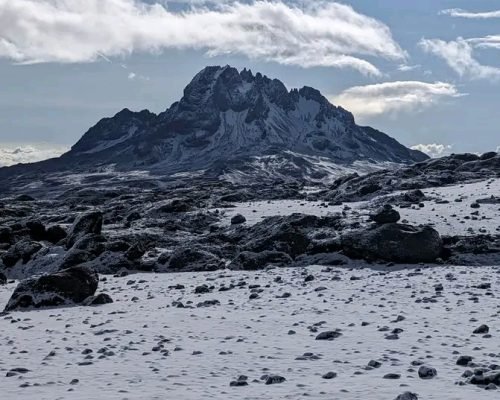
- Your summit push begins at midnight. You climb slowly using the “pole pole” method as stars illuminate the sky. After reaching Stella Point, you continue along the crater rim to Uhuru Peak, Africa’s highest point.
- Elevation: 4,680m → 5,895m → 3,100m
- Hiking Time: 12–15 hours
- Distance: 17 km
- Habitat: Arctic → Rainforest
- You descend to Barafu for brunch, then continue down to Mweka Camp for your final night on the mountain.
Day 9: Mweka Camp to Mweka Gate – Return to Arusha
- A gentle walk through the forest leads you to Mweka Gate where you receive your official summit certificate. After farewells with the mountain crew, your driver returns you to Arusha for a warm shower and celebration dinner.
- Elevation: 3,100m → 1,640m
- Hiking Time: 3 hours
- Distance: 10 km
- Habitat: Rainforest
What to pack
- Head lamp - 1pc
- Balaclava - 1pc
- Sun glass - 1pc
- Warm hat - 1pc
- Sun hat - 1pc
- Base Layer - 2pcs
- Top fleece - 2pcs
- Warm jacket/down jacket - 1pc
- Poncho - 1pc
- Long underwear - 2/3 pcs
- Sleeping bag - 1pc
- Warm trouser - 1pc
- Walk trouser - 2pcs
- Lip bum
- Sun cream lotion
What to pack
- Ski pant - 1pc
- Rain pant - 1pc
- Thin socks - 3pcs
- Thick socks - 3pcs
- Mountain Boot - 1pc
- Tennis shoe - 1pc
- Gators - 1pc
- Thin warm gloves - 1pc
- Thick Warm glove - 1pc
- Duffel bag/ rucksack - 1pc
- Day pack - 1pc
- Walking poles - 1pc
- Rain jacket/ wind breaker jacket
- First Aid Kit
- Baby wipes
Mountain crew
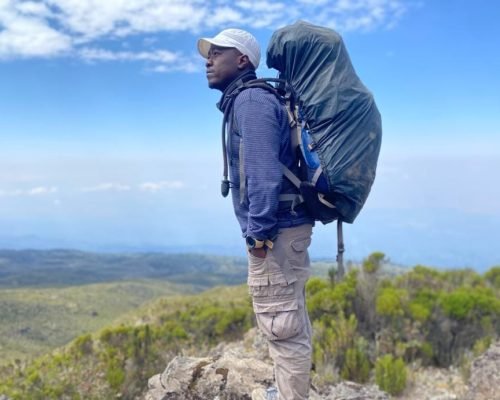
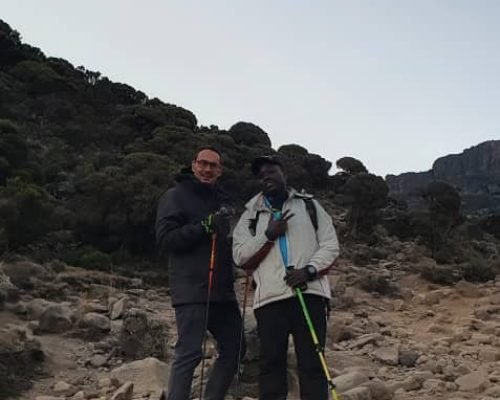
Apart from you, the mountain crew who accompany you are the most important people in Kilimanjaro. A good mountain crew will deliver an unforgettable summit – climb for all climbers. Experience is important to our crew, we have guides, cooks and porters who have been hiking Kilimanjaro well for over one hundred times– that experience is invaluable. Our guides are well trained, passionate and well knowledged on the flora and fauna of Mountain Kilimanjaro, and have gone through different First Aid courses in case of any emergency on the mountain. They are also very good at spotting altitude sickness and know what to do once it is spotted.
Money Matters
Visa and Mastercard are widely accepted in Tanzania , but note that American Express and Diners club are not accepted. In certain places, cash will be the only acceptable method of payment. Travelers should not rely on traveler’s cheques as these are not accepted in Tanzania .
The US dollar is always the best currency to carry and its important that the bank notes you bring have been printed after the year 2006, as older notes are often not accepted.
Tipping
Tipping is of course discretionary, but is an expected part of the way in which business is done in Tanzania. It counts as an expression of gratitude to those who – hopefully have made your experience an unforgettable one and enable you to directly reward those people.
We realize that both the process of giving tips and knowing how much to give can be difficult, so we provide the following guidance.
At the end of the climb, it is a good idea to hold a “Tipping ceremony” after breakfast on the last day the team gather and start singing some of the Kilimanjaro songs and after client/clients can have words to say to the crew and a leading guide will speak on behalf of the crew.
Tips can be placed in an envelope and given to the lead guide, who can distribute them to the crew (it is advisable to announces total amount in front of the group, so that all crew member are aware of how much is to be distributed) it is recommended the client can give from 250 US$ – 300 US$ per person per whole trip. An alternative method which mostly trekkers prefer is to give individual tips to the crew members, in which case the following amount can be used to guidance.
Chief guide $ 25US per day/per group
Assistant guide $20US per day/per group
Mountain chef $15US per day/per group
Mountain porter $8-10 US per day/per group
Giving more is also allowed. The above figures are only for guidance and can of course be varied at the trekker’s discretion. Gift of clothes, boots etc are also appreciated.